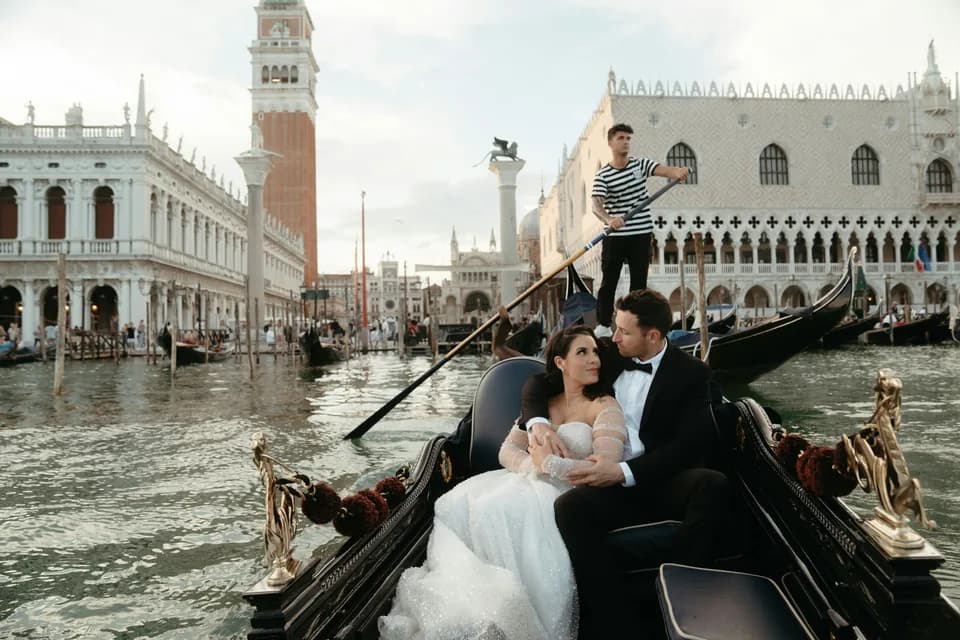
Getting Married in Venice · 13 min read
Published · Updated
In brief
Getting married in Venice is possible in three ways: a legal civil ceremony celebrated by the City of Venice (most often at Palazzo Cavalli on the Grand Canal), a symbolic ceremony with no paperwork, or a religious wedding arranged with a church or faith community. Foreign couples need a nulla osta (certificate of no impediment) for a civil wedding; many avoid the paperwork by marrying legally at home and holding a symbolic ceremony in Venice.
This guide walks through each option in plain English — who can do what, which documents you need, what the City of Venice charges, how long it all takes — and then covers the part most guides skip: how a wedding day actually works in a city without roads, where every guest arrives on foot or by boat.
We photograph weddings here, so the practical advice comes from the planning side of the camera: timelines built around gondolas and water taxis, portrait routes that avoid the crowds, and plan Bs for rain, fog and acqua alta. Where we quote fees and rules, we name the official source so you can check it before booking.
The three ways to get married in Venice
A civil wedding is the legal route. It is celebrated by an officer of the City of Venice (the Comune) in one of its official halls — Palazzo Cavalli, the halls of the town hall at Ca' Farsetti and Ca' Loredan, the Sala Cuoi d'Oro at Ca' Vendramin Calergi, Palazzo Persico in Malamocco, Villa Querini in Mestre — or in one of the private locations the Comune has authorised, such as the Scuola Grande della Misericordia. A civil wedding in Italy is legally valid, and your marriage certificate can be recognised at home. Our civil wedding guide covers it step by step.
A symbolic wedding has no legal effect: you marry legally at home (before or after the trip) and hold a ceremony in Venice that looks and feels like a wedding, led by a celebrant, a friend or nobody at all. Because there's no paperwork, you can hold it almost anywhere a venue allows — a palazzo, a hotel terrace, a garden. It's the most common format for foreign couples; see symbolic wedding in Venice and our comparison of civil vs symbolic.
A religious wedding is arranged with the relevant religious authority: the Catholic Patriarchate of Venice (through your home parish), the Jewish Community of Venice, the Greek Orthodox church of San Giorgio dei Greci, the Armenian monastery of San Lazzaro, or the Anglican chaplaincy (which offers blessings rather than legal weddings). Some religious weddings — notably Catholic ones — can also have civil effect in Italy; others are purely religious and require a civil marriage first. Read our guide to a church wedding in Venice.
Can foreigners get legally married in Venice?
Yes. Italian law allows foreign citizens to marry in Italy, including couples where neither partner is Italian or resident in Italy. What changes is the paperwork: each foreign partner must prove they are free to marry, which is what the nulla osta (or certificate of no impediment) does.
In practice the steps are: obtain the nulla osta (or its equivalent) from your country's authorities; have it legalised or apostilled where required; send your documents to the Comune's marriage office; attend a short meeting in Venice a few days before the wedding to confirm your intention to marry; and then hold the ceremony with two witnesses and, if you don't speak Italian, an interpreter. Our nulla osta guide explains the documents in detail, with specific guides for US citizens and UK citizens.
Requirements vary by nationality and can change, so treat any checklist — including ours — as a starting point and confirm with the Comune and with your own embassy or consulate.
Legal requirements to get married in Italy, in short
For a civil wedding in Italy you will typically need: valid passports; a nulla osta or equivalent certificate of no impediment for each foreign partner (for some nationalities, a sworn declaration at the consulate plus an 'atto notorio'); birth certificates where requested; evidence that any previous marriage has ended (divorce decree or death certificate); two witnesses over 18; and an interpreter if either of you doesn't understand Italian.
Documents issued abroad usually need an apostille (or legalisation) and a certified Italian translation, unless an international convention exempts them. The Comune tells you exactly what it needs once you contact the marriage office — ask early, because some documents take weeks to obtain.
Once married, you receive an Italian marriage certificate. For many countries, an international (multilingual) extract or an apostilled certificate is what you'll need to register the marriage at home.
Civil weddings at Palazzo Cavalli and the City Hall venues
Palazzo Cavalli is the City of Venice's main wedding hall: a Renaissance palazzo on the Grand Canal a few steps from the Rialto Bridge, with a hall whose whole wall of windows faces the water. The Comune also offers more exclusive halls for a supplement — the Sala degli Stucchi at Ca' Farsetti, the Sala del Consiglio at Ca' Loredan, the Sala Cuoi d'Oro at Ca' Vendramin Calergi — as well as Palazzo Persico in Malamocco on the Lido and an outdoor space at Villa Querini in Mestre from May to September.
The Comune's published fees depend on residency, citizenship and timing. At the time of writing, the base fee for a ceremony during office hours (Monday to Saturday, 8:45–13:00) is €700 for EU citizens and Italian non-residents and €1,700 for non-EU citizens, with higher fees for evenings, pre-holidays and holidays. The exclusive halls add a supplement (for example €9,000 for the Sala degli Stucchi and €5,000 for the Sala Cuoi d'Oro), and the authorised private locations are €10,000 all-inclusive. Always check the Comune's official tariff page before booking, as fees change.
Beyond the fees, the halls differ in atmosphere and logistics — see the individual pages for Palazzo Cavalli, Ca' Farsetti, Ca' Vendramin Calergi and La Pagoda on the Lido.
Symbolic ceremonies: the simplest way to marry in Venice
A symbolic ceremony is the choice of most couples who travel to Venice to marry. You handle the legal side at home — often a short registry-office wedding in the weeks before — and in Venice you're free to design the ceremony you want: in a palazzo ballroom, on a hotel terrace facing the Salute, in a garden on the Giudecca, or as a quiet exchange of vows on a bridge at sunrise.
Public spaces like St Mark's Square are not ceremony venues — you can't set up chairs or an arch there — but a couple reading vows to each other during a photo session is a different matter. We cover what is and isn't possible in can you get married in St Mark's Square? and can you get married on a gondola?.
Religious weddings: church, synagogue and other rites
Catholic weddings in Venice are arranged through the Patriarchate of Venice together with your home parish, which handles the pre-marriage preparation and paperwork. Popular churches include Santa Maria dei Miracoli, Santa Maria della Salute, the Frari and Madonna dell'Orto.
Other traditions have their own places and authorities: the synagogues of the Ghetto (through the Jewish Community of Venice), San Giorgio dei Greci for Greek Orthodox weddings, San Lazzaro degli Armeni for Armenian-rite ceremonies, and St George's Anglican Church for blessings. See our guides to a Jewish wedding and an Armenian wedding on San Lazzaro.
Same-sex weddings in Venice
Same-sex couples can form a civil union (unione civile) under Italian Law 76 of 2016. In Venice, civil unions are celebrated by the Comune in the same halls and under the same conditions as weddings, including Palazzo Cavalli. Foreign couples need documents similar to those for a marriage. Many couples already married at home choose a symbolic ceremony instead. Our full guide is same-sex civil unions in Italy.
How long does it take to organise?
For a wedding between May and October, most couples book the ceremony slot and key suppliers 9 to 12 months ahead; Saturdays and the most sought-after venues go first. Documents like the nulla osta are usually obtained in the final two to three months, because some have a limited validity.
An elopement or a small civil wedding can be organised in a few months, and a symbolic elopement with no guests can come together in weeks. Our how to elope in Venice guide and Venice wedding checklist break down the timeline.
What a wedding in Venice costs
The fixed, published costs are easy to list: the Comune's ceremony fees (above), official gondola fares (€90 for 30 minutes by day, €110 for 35 minutes after 7pm, per gondola), and the fees for documents and translations. Everything else — venue hire, catering, flowers, boats, a planner, photography — is quoted per wedding and varies widely with the season, day of the week and guest count.
For photography, market data helps: photographers listed for Venice on the MyWed directory charge roughly 140 to 950 USD per hour, most between about 220 and 345 USD, usually with a two-hour minimum. Our cost of getting married in Venice guide builds a full budget, and how much a wedding photographer costs in Italy looks at photography in detail.
Do you need a Venice wedding planner?
You don't need one for a symbolic elopement or a small civil ceremony, especially if your photographer and venue help with timings. For a wedding with guests, a local planner is usually worth it: they know which landing stages can be used, how to book boats for 60 people, which venues allow outside caterers and how the Comune's marriage office works. We look at the pros and cons in do you need a wedding planner in Venice?.
A realistic planning timeline
12 months out: decide between civil, symbolic and religious; choose the season; shortlist venues; contact the Comune's marriage office if you want a legal ceremony; book your photographer and, for a wedding with guests, a planner.
9–6 months out: confirm the venue and ceremony slot; book florist, hair and make-up, music and boats; send save-the-dates with travel advice (see our guest guide). For a Catholic wedding, start the preparation with your home parish.
3–1 months out: request the nulla osta or equivalent documents, apostilles and translations; confirm witnesses and interpreter; finalise the timeline around boats, tides and light.
The last week: attend the appointment at the Comune, check tide and weather forecasts, confirm every boat time, and hand the rings to someone you trust.
Common mistakes to avoid
Assuming you can marry anywhere. Legal ceremonies only take place in the Comune's halls or authorised venues; a hotel terrace or a public square is for symbolic ceremonies.
Leaving documents too late. Consular appointments and postal applications take weeks; some documents also have a limited validity, so the timing needs planning.
Underestimating transfers. Every move is on foot or by boat. A group in formal clothes crossing five bridges takes far longer than a map suggests.
Scheduling portraits at midday in famous places. St Mark's and Rialto are crowded from mid-morning; plan portraits at sunrise, in the evening, or in quieter districts.
Choosing the right season for your format
Civil ceremonies run all year in the Comune's halls; outdoor civil ceremonies at Villa Querini are possible only from May to September. Symbolic ceremonies outdoors are best from May to early October. Religious weddings follow the church's or community's calendar — Catholic weddings, for example, are usually not celebrated during certain liturgical seasons; ask the parish. Elopements work in every season, and winter fog can be the most atmospheric of all.
Guests, accessibility and comfort
Venice has around 400 bridges, many with steps, and no cars. For guests with limited mobility, choose venues with landing stages close to the entrance, arrange water taxis rather than walking routes, and consider hotels with lifts. The vaporetto is step-free at many stops, and some bridges have ramps, but routes need checking in advance.
In summer, heat and humidity can be tiring: plan ceremonies in the late afternoon, provide water and shade, and keep outdoor portrait sessions short.
Where to take the photographs
Most Venice weddings combine one or two iconic places with quieter spots near the venue. Around Palazzo Cavalli, the Rialto Bridge and the canals of San Marco; around the Grand Canal hotels, landing stages and bridges with water views; around the Giudecca, the fondamenta facing the city. For the empty-square images at St Mark's, a sunrise session on the day after is the most relaxed solution. See the best places for wedding photos in Venice.
Getting married in Venice: the options at a glance by guest count
Just the two of you: a symbolic elopement at sunrise, or a civil ceremony at Palazzo Cavalli with two witnesses (who can be arranged by a planner). Up to 20 guests: civil or symbolic ceremony, then lunch or dinner in a restaurant's private room. 20–80 guests: a Grand Canal hotel or exclusive palazzo for a symbolic ceremony and reception, with the legal part at the Comune or at home. 80+ guests: island resorts, the Lido, the Scuola della Misericordia.
How a wedding day works in Venice
Everything moves on foot or on water. The couple usually crosses the city by gondola or water taxi; guests walk or take private launches to the venue. A realistic timeline builds in extra minutes for every transfer, because boats wait for no one and bridges slow down a group in formal clothes. Our wedding boat guide and guest guide cover the logistics.
Light and crowds shape the photographs. St Mark's Square and the Rialto Bridge are crowded by mid-morning, so portraits there are planned for sunrise — often as a day-after session — or for the evening. From October to January the tide matters too: acqua alta can flood the lowest parts of the city for a few hours. See acqua alta on your wedding day and the best time for wedding photos in Venice.
If you'd like us to photograph your day, our luxury wedding, elopement and Palazzo Cavalli civil wedding collections are each built around these realities.
| Civil wedding | Symbolic wedding | Religious wedding | |
|---|---|---|---|
| Legally valid | Yes | No — marry legally at home | Depends on the rite (Catholic can have civil effect; others need a civil marriage) |
| Where | Comune's halls or authorised venues | Almost anywhere a venue allows | The relevant church, synagogue or community |
| Paperwork | Nulla osta or equivalent, translations, apostilles | None in Italy | Religious documents plus civil ones if legal effect is needed |
| Who officiates | City of Venice officer | Celebrant, friend or nobody | Priest, rabbi or minister |
| Typical lead time | 3–12 months | Weeks to months | 6–12 months (Catholic preparation) |
Official source
Civil marriage in Venice
The City's official page for civil weddings: venues, booking, fees and required documents (in Italian).
Comune di Venezia — Civil marriage in Venice ↗Frequently asked questions
Is it hard to get married in Venice as a foreigner?
Not hard, but it takes organisation. The key is the nulla osta or equivalent document from your country, plus translations and apostilles. Many couples avoid the paperwork by marrying legally at home and holding a symbolic ceremony in Venice.
How much does it cost to get married at Palazzo Cavalli?
The Comune's published base fee for non-EU couples is €1,700 in office hours (€700 for EU citizens and Italian non-residents), with higher fees for evenings and holidays. Check the official tariffs before booking.
Can we get married in St Mark's Square?
No ceremony can be set up in the square, but you can exchange private words there during a photo session, ideally at sunrise.
Can same-sex couples marry in Venice?
Yes, through a civil union under Italian Law 76/2016, celebrated by the Comune in the same halls as weddings.
Do we need witnesses?
Yes, a civil wedding in Italy requires two witnesses over 18; they can be your guests, and some couples ask their planner to arrange them.
When should we book our Venice wedding photographer?
For May–October weddings, as soon as you have a date — usually 9 to 12 months ahead. Elopements and proposals can often be booked a few months out.
How many days before the wedding do we need to be in Venice?
For a civil wedding, plan to arrive a few working days before the ceremony, because foreign couples attend an appointment at the Comune beforehand, and some nationalities also need consular or Prefettura appointments in Italy.
Can we get married in Venice on a Sunday?
The Comune celebrates on holidays at a higher fee; symbolic ceremonies depend on the venue; religious weddings on Sundays depend on the church or community.
Is Venice accessible for guests in wheelchairs?
Partly — many vaporetto stops are step-free and some areas are flat, but bridges with steps make planning essential; water taxis help.
Can we get married in Venice without a planner?
Yes for elopements and small weddings; for larger weddings, a local planner makes boats, venues and suppliers much easier.
What language is the civil ceremony in?
Italian, with an interpreter translating if needed.
Can we get married in a gondola?
Not legally — but a symbolic exchange of vows on a gondola is possible. See can you get married on a gondola?.